
.png)
Can Haze Cause Hair Loss in Singapore? What the Science Says

Written by Dr Heng Jiacheng, MBBS, Diploma in Aesthetic Medicine (AAAM)Associate Member, International Society of Hair Restoration Surgery (ISHRS) · Member, Asian Association of Hair Restoration Surgeons (AAHRS). Insights from a Singapore-based hair-loss physician
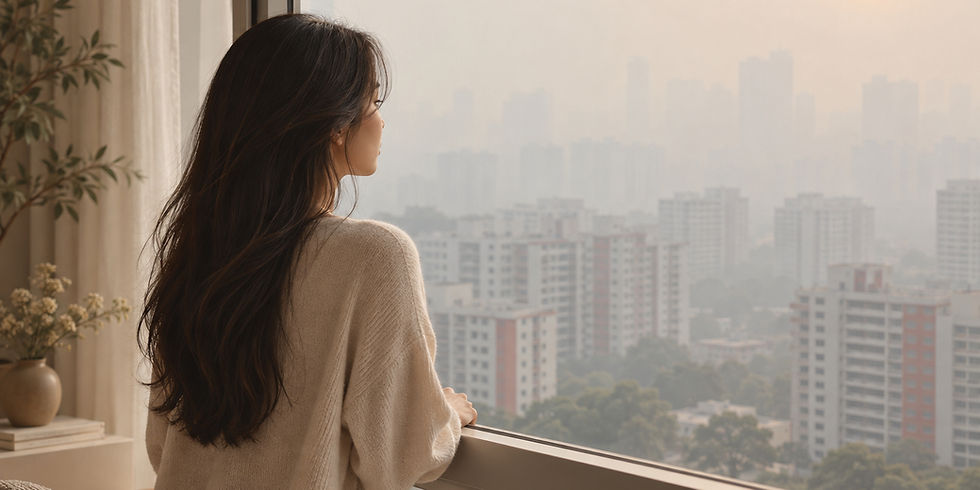
TL;DR: Long-term air pollution may contribute to hair loss through oxidative stress and inflammation, but a few days of Singapore haze are unlikely to suddenly make your hair fall out.
Singapore's haze has been worsening, with air quality entering the unhealthy range in parts of the country and doctors reporting more patients presenting with respiratory symptoms such as cough, throat irritation and breathing difficulties.
Most of the conversation has understandably focused on our lungs.
But does haze affect our hair too?
Curious myself, I went on a deeper dive into the research.
And surprisingly, air pollution is increasingly being linked to hair loss, through both large epidemiological studies and laboratory evidence.
There is one important caveat: Most of this research looks at long-term exposure to particulate matter, rather than a few isolated days of haze in Singapore.
So, what does the science actually show?
What exactly is in Singapore's haze?
Singapore's 24-hour Pollutant Standards Index (PSI) is calculated using six major air pollutants:
PM2.5
PM10
ozone
sulphur dioxide
nitrogen dioxide
carbon monoxide
Each pollutant produces its own sub-index, with the highest sub-index determining the overall PSI.
During haze episodes, PM2.5 is typically the dominant pollutant of concern. PM2.5 refers to fine particulate matter measuring 2.5 micrometres or less in diameter, while PM10 refers to particles measuring up to 10 micrometres.
Air pollution and pattern hair loss
One of the most interesting studies was published in JAAD International in 2026.[1]
Researchers examined a nationwide Korean cohort and followed participants for a median of 12.5 years, comparing long-term residential exposure to particulate pollution with the development of androgenetic alopecia - really impressive duration to be honest.
Androgenetic alopecia AKA male or female pattern hair loss is the most common cause of progressive hair thinning.
They found that for every 10 μg/m³ increase in long-term exposure:
PM2.5 was associated with a 44% higher rate of developing androgenetic alopecia
PM10 was associated with a 61% higher rate of developing androgenetic alopecia
Researchers also found a clear dose-response relationship: as long-term particulate exposure increased, the observed risk of androgenetic alopecia increased progressively.
This does NOT mean a rise in Singapore's haze today increases your chance of losing your hair by 44% tomorrow.
The study looked at long-term average pollution exposure over years, not temporary spikes during individual haze episodes.
It was also an observational study, that means it can demonstrate an association, but it cannot prove that particulate pollution directly caused the hair loss.
Truth be told, genetics and androgen sensitivity remain the major drivers of androgenetic alopecia.
Instead, this study raises an interesting possibility: Air pollution may be another environmental stressor acting on an already susceptible hair follicle.
Air pollution has also been linked to alopecia areata
Pattern hair loss is not the only type of alopecia associated with particulate pollution.
Another nationwide study published in the British Journal of Dermatology in 2026 investigated long-term particulate exposure and alopecia areata.[2]
Alopecia areata is an autoimmune condition in which the immune system attacks the hair follicle, typically causing discrete patches of hair loss.
For every 10 μg/m³ increase in long-term exposure:
PM2.5 was associated with a 45% higher rate of developing alopecia areata
PM10 was associated with a 32% higher rate of developing alopecia areata
The strongest association was seen with alopecia universalis, the most extensive form of alopecia areata involving widespread loss of scalp and body hair.
For alopecia universalis:
PM2.5 was associated with a 123% higher rate of developing alopecia universalis
PM10 was associated with an 82% higher rate of developing alopecia universalis
Again, this remains an association rather than proof of causation.
So how could haze actually affect our hair?
There are several ways particulate air pollution could potentially affect either the hair follicle or the hair fibre itself.
1. Oxidative stress: particulate matter increases ROS
One of the strongest proposed mechanisms is oxidative stress.
Our cells naturally produce reactive oxygen species, or ROS, as part of normal cellular processes.
But excessive ROS can damage proteins, lipids and DNA and activate inflammatory pathways.
In the same 2026 alopecia areata study, researchers exposed human hair follicle outer root sheath cells to PM10-like fine dust. Particulate exposure increased reactive oxygen species production.
It also increased several pro-inflammatory signals, including:
IL-1β
IL-6
IL-8
IL-15RA
Researchers also observed activation of inflammatory signalling pathways.
So within the same study, we have:
Population data:Higher long-term particulate exposure was associated with more alopecia areata.
Laboratory data:Particulate matter increased oxidative stress and inflammatory signalling in human hair follicle cells.
That gives us a biologically plausible pathway:
Particulate matter → increased ROS → inflammation around the hair follicle
2. Particulate matter may directly damage follicular cells
A separate laboratory study published in Annals of Dermatology investigated what particulate matter does to human scalp hair follicles and hair follicular keratinocytes.[3]
Researchers exposed cultured human hair follicles to particulate matter.
They found:
increased ROS production
increased inflammatory genes and cytokines
reduced follicular cell viability
increased apoptosis, or programmed cell death
Apoptotic cells were found in several parts of the follicle, including the outer root sheath, inner root sheath and hair bulb.
The researchers proposed that particulate matter may potentially impair hair growth through a combination of oxidative stress, inflammation and follicular cell death.
Again, this was laboratory research.
The concentrations used in a laboratory cannot simply be translated into:
“X days of Singapore haze = X amount of hair loss.”
But it provides another plausible mechanism for what we are seeing in the epidemiological studies.
3. Inflammation may create an unfavourable environment around the follicle
Oxidative stress and inflammation are closely linked. When reactive oxygen species increase, they can activate inflammatory signalling and increase the release of inflammatory cytokines.
This is particularly relevant to alopecia areata, where inflammation around the hair follicle is a central part of the disease process.
For androgenetic alopecia, the mechanism is different.
Pattern hair loss is primarily driven by genetic susceptibility and androgen signalling, particularly the effects of dihydrotestosterone (DHT) on susceptible follicles. However, miniaturising follicles in androgenetic alopecia have also been associated with oxidative stress and low-grade perifollicular inflammation.
This raises the possibility that particulate pollution does not cause androgenetic alopecia by itself, but may contribute to an already pro-inflammatory environment around susceptible follicles.
In simpler terms: DHT remains the main driver of pattern hair loss - but additional oxidative stress and inflammation may potentially add further stress to an already vulnerable follicle.
4. Pollution may disrupt the scalp barrier
The scalp is still skin.
And particulate pollution has increasingly been studied for its effects on skin-barrier function.
Experimental research has shown that urban particulate matter can reduce filaggrin, an important protein involved in maintaining a healthy epidermal barrier.
Other pollution research has also demonstrated increased oxidative stress and inflammatory signalling within the skin.
However, much of this research has been performed on skin generally rather than specifically on the human scalp.
So this remains a plausible mechanism rather than evidence that haze directly causes scalp disease or hair loss.
5. Pollution may damage the hair itself
There is another important distinction.
Hair loss from the follicle and damage to the hair shaft are not the same thing.
Air pollution may potentially affect both.
A 2019 study published in Proceedings of the National Academy of Sciences examined 204 human hair samples from two Chinese cities with different pollution exposures.[4]
Researchers measured exposure to polycyclic aromatic hydrocarbons (PAHs) pollutants produced during incomplete combustion and examined the microscopic structure of the hair fibres.
Hair containing greater PAH concentrations demonstrated accelerated:
degradation of the hair cortex
cuticle delamination
structural deterioration
And when those hair fibres were subsequently exposed to ultraviolet radiation, the damage became even more pronounced.
Clinically, breakage can also make someone's hair appear thinner.
HOW relevant is this to Singapore?
A quick look at previous Singapore studies does show that PAHs are present during haze episodes, although generally at relatively low levels.
So I wouldn’t worry that a few hazy days are suddenly going to destroy your hair.
But with chronic exposure, especially at higher pollution levels, PAHs could potentially contribute to more hair-shaft damage and breakage over time.
There is also emerging animal evidence
Animal studies provide another piece of the puzzle.
A 2025 mouse study investigating PM2.5 exposure after pregnancy found increased scalp hair loss together with changes in inflammatory and apoptotic pathways and reductions in hair follicle stem-cell populations.[5]
This suggests that particulate pollution may potentially interfere with normal follicular regeneration.
But this needs to be interpreted carefully.
It was a mouse study.
So, will Singapore's current haze cause hair loss?
This is probably the most important question.
Based on the evidence we currently have, a few days of haze are unlikely to suddenly make your hair fall out.
Almost all of the strongest human evidence relates to long-term exposure to particulate pollution over years.
We currently do not have good evidence showing that several days or weeks of elevated haze in Singapore directly trigger significant hair loss in an otherwise healthy person.
And if you suddenly notice more hair falling today, yesterday's haze is unlikely to be the explanation.
For example, telogen effluvium usually becomes apparent around two to three months after a significant physiological trigger, rather than immediately.
Common triggers include:
significant illness or fever
surgery
rapid weight loss
nutritional deficiencies
childbirth
certain medications
significant physiological stress
So timing matters.
If you are suddenly shedding more hair during the haze period, it may be more useful to ask:
What was happening two or three months ago?
Frequently Asked Questions
Can haze cause hair loss?
Yes, Long-term exposure to particulate air pollution has been associated with androgenetic alopecia and alopecia areata in large observational studies. However, there is currently insufficient evidence that a short Singapore haze episode directly causes sudden hair loss.
Can Singapore haze make thinning hair worse?
Unlikely. Long-term particulate pollution has been associated with androgenetic alopecia, while laboratory research suggests oxidative stress and inflammation may affect follicular cells. Genetics and androgen sensitivity remain the main drivers of pattern hair loss.
Can haze cause alopecia areata?
Yes, Long-term particulate pollution exposure has been associated with a higher rate of alopecia areata, particularly alopecia universalis, in a large nationwide epidemiological study. However, association does not prove that haze directly causes the condition.
Can haze cause telogen effluvium?
No, there is currently insufficient evidence that short-term haze causes telogen effluvium. Telogen effluvium typically becomes noticeable around two to three months after a significant physiological trigger.
Does haze damage hair?
Potentially. Research has linked greater exposure to pollution-related PAHs with accelerated degradation of the hair cortex and cuticle, particularly when combined with UV exposure. This may contribute to weakening and breakage rather than true follicular hair loss.
Can PM2.5 cause hair loss?
Long-term PM2.5 exposure has been associated with androgenetic alopecia and alopecia areata in observational studies. Laboratory evidence also suggests particulate pollution may increase oxidative stress and inflammatory signalling around hair follicle cells. This does not yet prove direct causation in an individual person.
Should I wash my hair after haze exposure?
Normal washing with a gentle shampoo after significant outdoor exposure is reasonable. There is currently no evidence that specialised “anti-pollution” or detox shampoos prevent pollution-related hair loss.
Should I take antioxidants because of the haze?
There is currently no evidence that antioxidant supplements specifically prevent haze-related hair loss. Nutritional supplementation should instead be based on individual requirements and genuine deficiencies.
References
1. Park JY, Nam J, Lee J, et al. Long-term particulate matter exposure and risk of androgenetic alopecia: A nationwide cohort study. JAAD International. 2026;27:146–148. doi:10.1016/j.jdin.2026.06.008.
2. Kim M, Nam J, Lee J, et al. Long-term particulate matter exposure and risk of alopecia areata: a nationwide epidemiological study with preliminary in vitro evidence. British Journal of Dermatology. 2026. doi:10.1093/bjd/ljag254.
3. Jun MS, Kwack MH, Kim MK, Kim JC, Sung YK. Particulate Matters Induce Apoptosis in Human Hair Follicular Keratinocytes. Annals of Dermatology. 2020;32(5):388–394. doi:10.5021/ad.2020.32.5.388.
4. Naudin G, Bastien P, Mezzache S, et al. Human pollution exposure correlates with accelerated ultrastructural degradation of hair fibers. Proceedings of the National Academy of Sciences. 2019;116(37):18410–18415. doi:10.1073/pnas.1904082116.
5. Jung GS, Lee MJ, Im W, et al. Particulate Matter Exposure Induces Maternal Scalp Hair Loss After Birth in C57/B6 Mouse via Alteration of Inflammatory and Apoptotic Pathways. Frontiers in Endocrinology. 2025.
6. Abolhasani R, Araghi F, Tabary M, et al. The Impact of Air Pollution on Skin and Related Disorders: A Comprehensive Review. Dermatologic Therapy. 2021.
7. Boonpethkaew S, Charoensuksira S, Meephansan J, et al. The influence of air pollution on skin microbiome: a link to skin barrier dysfunction. Archives of Dermatological Research. 2024.
8. Lee CW, Lin ZC, Hu SC, et al. Urban particulate matter down-regulates filaggrin via COX2 expression/PGE2 production leading to skin barrier dysfunction. Scientific Reports. 2016;6:27995.


Comments