
.png)
Biotin and Hair Loss: What the Evidence Actually Says

Updated: Jun 26
Written by Dr Heng Jiacheng, MBBS, Diploma in Aesthetic Medicine (AAAM)Associate Member, ISHRS · Member, AAHRS. Insights from a Singapore-based hair-loss physician
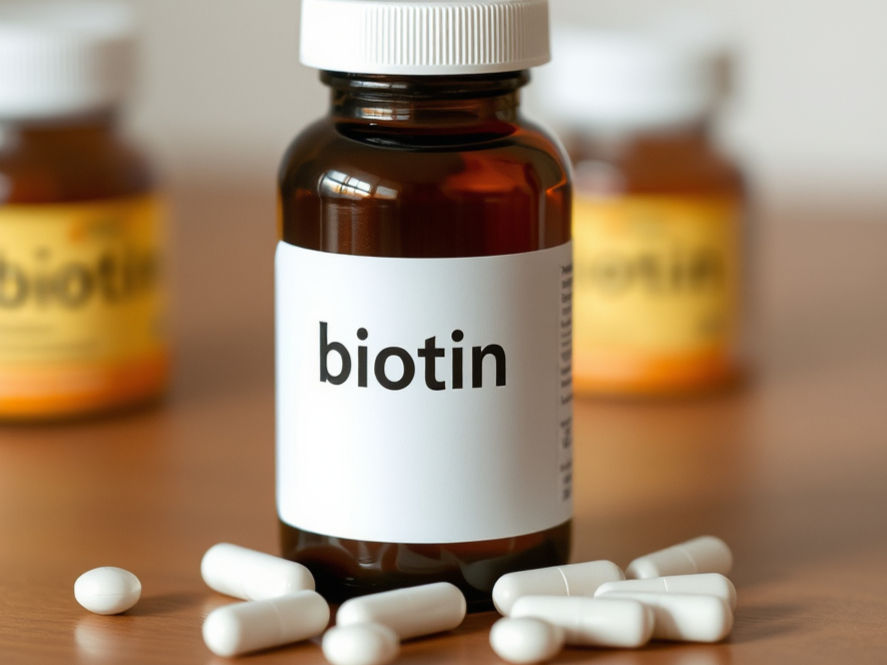
Biotin is one of the most purchased hair supplements in Singapore. Walk into any Watsons or Guardian and you will find it prominently displayed, often at doses of 5,000mcg or higher, with claims about thicker, stronger, faster-growing hair. Or even biotin gummies - my good friend swears by them.
The clinical evidence tells a more complicated story.
What Biotin Actually Does
Biotin is a B-vitamin that functions as a cofactor in carboxylase enzymes involved in keratin production, the structural protein that makes up hair.
This biochemical role is real, and it forms the biological basis for the assumption that more biotin means better hair.
The problem is that this logic only holds when biotin is deficient. In individuals with normal biotin levels, adding more does not enhance keratin production further. The pathway is already adequately supported.
True biotin deficiency does cause hair loss- however it is rare in healthy adults eating a normal diet, and especially so in the context of Singapore. It occurs in specific contexts: inherited metabolic defects affecting biotin metabolism, acquired deficiency from alcoholism or inadequate intake during pregnancy, heavy consumption of raw egg whites (which contain avidin, a protein that binds biotin and prevents absorption), and certain long-term medications. Outside these scenarios, the average person presenting at a hair loss clinic is almost certainly not biotin deficient. [2]
What the Research Shows
The gap between biotin's popularity and its evidence base is striking.
A 2023 systematic review in JAMA Dermatology found that biotin monotherapy for alopecia has not been studied in controlled trials.
Biotin appears as a component in some combination nutritional supplements, but its individual contribution has never been isolated and tested. [1] A 2017 review reached the same conclusion - no clinical trials have investigated biotin supplementation for treating any type of alopecia, and no randomised controlled trials have studied its effect on hair quality or quantity in humans. [3]
One randomised controlled trial did show significant improvement in hair loss using intramuscular injections of biotin combined with dexpanthenol in patients with diffuse hair loss. But this was a combination therapy administered by injection - it does not establish what biotin alone does, taken orally, in a person without deficiency. [5]
The current evidence is insufficient to recommend biotin supplements in dermatological practice. [4]
Despite this, a study found that 81% of patients attending a hair loss clinic were using supplements, with biotin among the most frequent choices. [1] Popularity has vastly outpaced evidence.
The Dose Problem
The recommended daily intake of biotin is approximately 30mcg. Most hair supplements on the market contain 2,500 to 10,000mcg - roughly 80 to 300 times the daily requirement.
The body excretes excess biotin renally, so toxicity is not the concern. The concern is interference with laboratory testing.
The FDA has formally warned that high-dose biotin supplementation can interfere with immunoassay-based blood tests, including troponin (used to diagnose heart attacks) and thyroid hormone assays, producing falsely elevated or falsely decreased results. [1] This is not a theoretical risk - it has contributed to diagnostic errors in clinical settings. Patients taking high-dose biotin should stop supplementation three to seven days before any blood test and inform their doctor. This is something I routinely advise patients who come to me for blood testing while taking high-dose biotin supplements.
This warning is rarely mentioned on supplement labels.
What This Means in Practice
Biotin is not harmful at the doses found in supplements, and it is a reasonable component of a broader hair supplement formula at physiological doses. But as a standalone treatment for hair loss in someone without deficiency, it is not supported by evidence. [3,4]
The most common presentations at a hair loss clinic - gradual pattern thinning, diffuse shedding after stress or illness, postpartum hair changes — are unlikely to be caused by biotin deficiency. Supplementing biotin in these patients addresses something that is not broken.
This is why the Roots² protocols include biotin at physiological rather than inflated doses. The goal is coverage in the rare case of true deficiency - not chasing a number on a label. Most commercial supplements compete on mcg counts. That is a marketing decision, not a clinical one.
What these conditions do respond to, with varying levels of evidence, are treatments that address their actual underlying mechanisms: DHT modulation in androgenetic alopecia, hair cycle support and stress adaptation in telogen effluvium, and targeted micronutrient replenishment in postpartum shedding.
Hair loss is rarely a single-nutrient problem. The persistence of biotin as the dominant hair supplement in Singapore reflects effective marketing more than clinical reality.
References
Drake L, Reyes-Hadsall S, Martinez J, et al. Evaluation of the safety and effectiveness of nutritional supplements for treating hair loss: a systematic review. JAMA Dermatology. 2023. https://jamanetwork.com/journals/jamadermatology/fullarticle/10.1001/jamadermatol.2022.4867
Kim M, Basharat A, Santosh R, et al. Reuniting overnutrition and undernutrition, macronutrients, and micronutrients. Diabetes/Metabolism Research and Reviews. 2019. https://onlinelibrary.wiley.com/doi/10.1002/dmrr.3072
Soleymani T, Lo Sicco K, Shapiro J. The infatuation with biotin supplementation: is there truth behind its rising popularity? A comparative analysis of clinical efficacy versus social popularity. Journal of Drugs in Dermatology. 2017. https://pubmed.ncbi.nlm.nih.gov/28628687
Thompson KG, Kim N. Dietary supplements in dermatology: a review of the evidence for zinc, biotin, vitamin D, nicotinamide, and Polypodium. Journal of the American Academy of Dermatology. 2021. https://pubmed.ncbi.nlm.nih.gov/32360756
Samadi A, Ketabi Y, Firooz R, Firooz A. Efficacy of intramuscular injections of biotin and dexpanthenol in the treatment of diffuse hair loss: a randomized, double-blind controlled study comparing two brands. Dermatologic Therapy. 2022. https://pubmed.ncbi.nlm.nih.gov/35791704


Comments